
Pests and Diseases
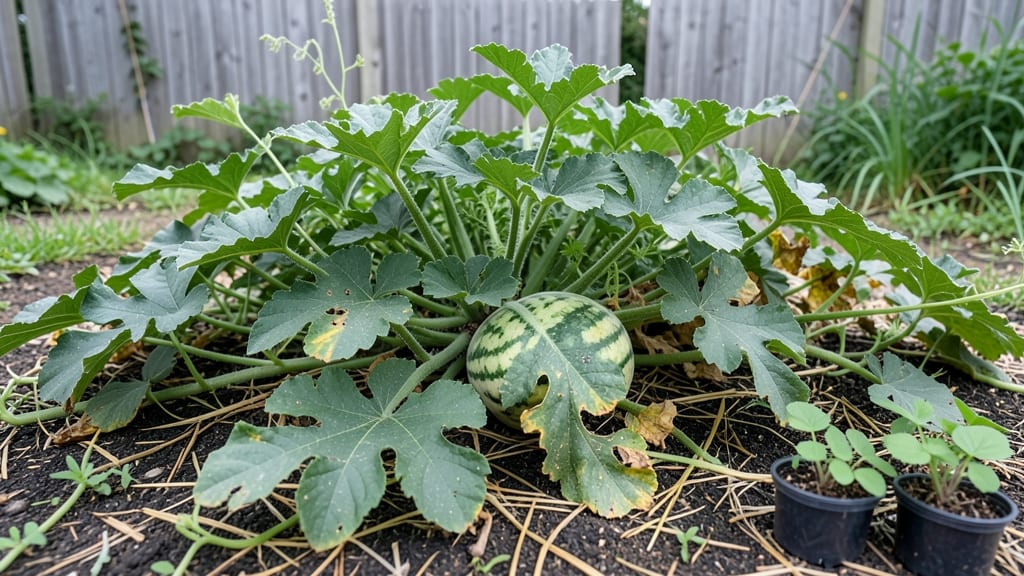
You can plant watermelon and strawberries together in containers or raised beds, but never directly in the same in-ground space because their soil, water, and sunlight needs clash. Success depends on careful spacing and soil management.
This pairing works surprisingly well when you control the environment—think of it like roommates with very different habits sharing a tiny apartment. 🌱 Watermelons need 6-8 hours of full sun and deep watering every 2-3 days, while strawberries thrive in partial shade with consistent moisture.
The key is using separate containers or dividing raised beds with landscape fabric to prevent root competition. I’ve seen gardeners grow both together beautifully in 5-gallon pots for watermelons and strawberry towers nearby, creating a productive micro-ecosystem.
What’s fascinating is how their growth habits complement each other when spaced properly. Watermelons act as living mulch, shading strawberry leaves from intense afternoon sun while their sprawling vines deter pests like slugs.
However, watch for powdery mildew on watermelons—strawberries’ acidic soil can create the perfect breeding ground if drainage isn’t perfect. Always use a well-draining potting mix with added perlite for containers.
💡 In This Article
- Soil and Growth Requirements for Watermelon vs Strawberries
- Container Gardening Solutions for Companion Planting
Soil and growth requirements for watermelon vs strawberries
The root of their incompatibility in open ground lies in their soil chemistry. Strawberries crave acidic soil with a pH of 5.5-6.5, while watermelons prefer slightly acidic to neutral soil at 6.0-7.0. This 1.0 pH difference might seem minor, but it drastically affects nutrient availability.
Strawberries need high levels of iron and manganese, which become locked out in neutral soil, while watermelons thrive when calcium and magnesium are abundant—precisely the minerals that dissolve better in alkaline conditions. 🌱
Water needs create another critical divide. Watermelons demand deep, infrequent watering—think soaking the soil 6-8 inches deep every 2-3 days—to develop their heavy fruits. Strawberries, however, require consistent surface moisture, needing water every 1-2 days to prevent their shallow roots from drying out.
The contrast is like trying to water a desert plant and a tropical orchid with the same schedule: one will drown while the other wilts. In containers, this becomes manageable with separate irrigation systems, but in-ground planting creates a battleground where neither gets what it truly needs.
Space requirements reveal their architectural differences. A single watermelon vine can spread 10-15 feet with vines reaching 3-6 feet long, while strawberry plants stay compact at 1-2 feet wide.
This sprawling habit isn't just about room—watermelons need space to photosynthesize efficiently through their broad leaves, while strawberries benefit from air circulation to prevent fungal diseases. When planted together in-ground, watermelons will shade out strawberries by mid-summer, creating a cool, humid microclimate that invites powdery mildew on both crops.
Here's where container gardening solves the puzzle: separate pots eliminate root competition while allowing you to tailor soil conditions. Use 5-gallon containers for watermelons with a 60/40 mix of potting soil and compost, and hanging strawberry pots with peat moss-heavy mix to maintain acidity.
The key is monitoring soil moisture with fingers—watermelon soil should feel damp 2 inches down, while strawberry soil stays consistently moist at the surface. This precision mimics their natural habitats: watermelons in sandy riverbanks vs. strawberries in acidic forest clearings.
What most gardeners miss is how these differences affect nutrient uptake timing. Strawberries are early-season feeders, needing nitrogen-rich fertilizers in spring, while watermelons are late-season heavy consumers of potassium and phosphorus.
In containers, you can fertilize them separately—strawberries every 2 weeks with 10-10-10, watermelons monthly with 5-10-10 once vines appear. This synchronization prevents one plant from starving the other, creating a harmonious growing system that would never work in shared in-ground space.