Companion Plants
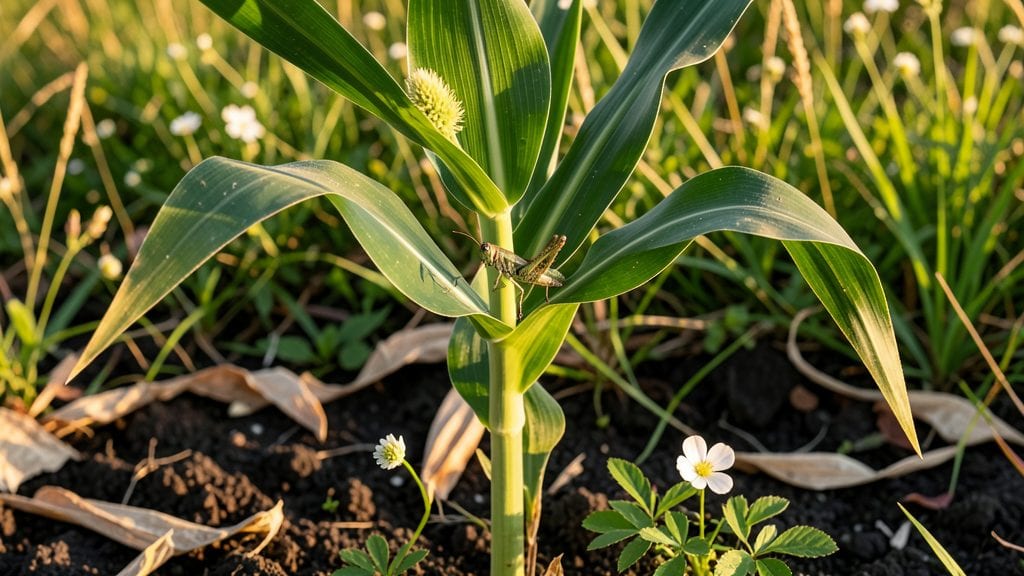
Grasshoppers on plants damage foliage by chewing leaves, stems, and flowers, often targeting young shoots and tender plants like beans, corn, and grasses. They thrive in warm, dry climates and multiply rapidly, requiring early intervention to prevent garden destruction.
Grasshoppers become a garden menace when they strip plants of their greenery, leaving behind jagged edges and skeletonized leaves. 🌱 These insects prefer tender, nutrient-rich foliage, particularly in drought-stressed plants that emit stronger chemical signals.
Their rapid reproduction—up to 15 eggs per pod—means a small infestation can explode into thousands within weeks. The key to protection lies in understanding their behavior and acting before they establish dominance in your garden.
What makes them so destructive is their indiscriminate feeding pattern: they don't just nibble—they devour entire plants in days. Young seedlings are especially vulnerable, as grasshoppers can completely defoliate them before they even get a chance to mature.
Warm, sunny conditions accelerate their activity, which is why late summer often sees the worst outbreaks. The good news? Natural predators like birds and parasitic wasps can help keep populations in check if given the right habitat.
💡 In This Article
- Why Grasshoppers Target Specific Plants
- Natural Grasshopper Control Methods for Gardens
Why grasshoppers target specific plants
Grasshoppers use a combination of scent and visual cues to identify their preferred meals. Their antennae detect volatile organic compounds (VOCs) emitted by stressed plants—especially those suffering from drought or nutrient deficiencies.
For example, corn plants under water stress release higher levels of terpenes, which act like a dinner bell to these insects. The key factor is plant chemistry: tender, young leaves contain higher levels of nitrogen and water, making them irresistibly soft and nutrient-dense compared to mature foliage.
Here's what's actually happening on a cellular level: Grasshoppers' mandibles are designed to crush plant cell walls, releasing sap that they lap up like nectar. 🌱 Their saliva contains enzymes that break down cellulose, allowing them to extract maximum nutrition from each bite.
This is why they prefer broadleaf plants like beans and grasses over woody stems—they can't efficiently process the tougher lignin compounds found in mature plant structures. Even the leaf's surface texture matters: smooth, thin leaves offer less resistance than rough, waxy ones.
Environmental conditions create perfect storm scenarios for grasshopper attacks. Drought-stressed gardens become hotspots because plants emit distress signals that grasshoppers find irresistible. Overcrowded plantings provide both shelter and easy access to multiple food sources.
The life cycle stages amplify this—nymphs (baby grasshoppers) are particularly destructive because they need to consume 20-30 times their body weight daily to molt into adults. A single female can lay up to 15 pods containing hundreds of eggs, meaning one season's infestation can become next year's epidemic.
What most people don't realize is how grasshoppers' feeding habits change with plant maturity. Early in the season, they target seedlings and soft new growth, but as plants mature, they'll switch to more fibrous leaves—though never completely abandoning their preference for tender tissues.
This explains why you might see damage on both young beans AND mature corn in the same garden. The science behind this involves their sensory receptors adapting to different plant chemistries as seasons progress.
Consider these key factors when assessing plant vulnerability:
- Water status: Plants with 20-30% lower moisture content emit stronger attractant signals
- Nitrogen levels: Young leaves contain 3-5x more nitrogen than mature leaves
- Leaf structure: Thin leaves (0.1mm thickness) are 4x more vulnerable than thick ones
- Plant spacing: Gardens with less than 12 inches between plants attract more grasshoppers
The most critical window for prevention is during the nymph stage when they're most active and least mobile. A single square foot of garden can support hundreds of nymphs during peak season, making early intervention the difference between a thriving garden and a skeletonized landscape. 💫